
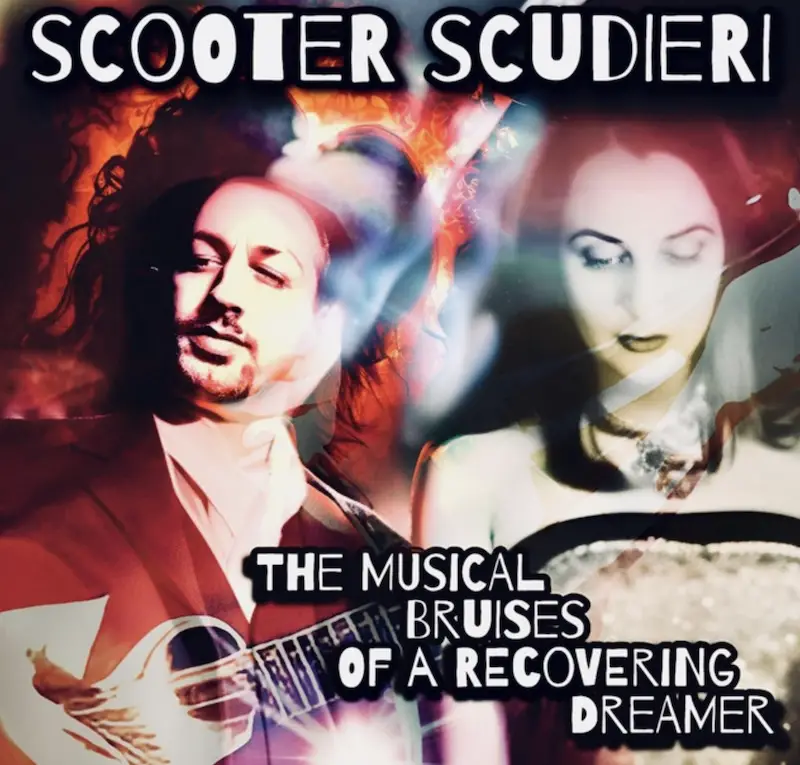
Scooter Scudieri documents a long return on new album ‘The Musical Bruises of a Recovering Dreamer’
Scooter Scudieri’s ‘The Musical Bruises of a Recovering Dreamer’ arrives with an unusually elaborate story around it. The West Virginia singer-songwriter spent seven years completing the twelve-track album in his basement studio while continuing to work full-time as a house painter. Its release is also being organised through a personalised management system developed within ChatGPT, creating an experiment in how artificial intelligence might support an independent artist without participating in the actual songwriting or recording.
That surrounding framework is interesting, but the album is most convincing when considered as the work of someone attempting to reconnect the different periods of a long creative life.
Scudieri is not an unknown musician beginning at 57. His earlier career included touring with Jewel and Jason Mraz, supporting established rock acts, appearing on Mountain Stage and receiving recognition from the Songwriters Hall of Fame. He was also involved in debates around artists’ rights during the expansion of digital music. Yet those achievements didn’t produce a conventional long-term industry career, and much of this record appears shaped by the distance between early promise and later reality.
Musically, the album draws heavily from classic album-oriented rock and singer-songwriter traditions. Guitars, piano, synthesisers, organic drums and pronounced bass lines give the songs a broad, familiar foundation. The arrangements often favour substantial melodies and layered vocal harmonies over minimalism, reflecting a period when records were expected to develop across a full sequence rather than function mainly as sources of individual singles.
And that approach gives the album a clear sense of intention, although its ambition occasionally creates a certain density. The frontman is willing to move between intimate reflection, theatrical gestures, playful vocal choices and larger rock arrangements, sometimes within the same song. The results are not always restrained, but they remain recognisably personal.
The sequencing is also important. These twelve songs have been arranged to suggest a movement from exhaustion and disappointment towards affection, memory and a qualified form of hope. The album doesn’t entirely escape the past, nor does it claim that perseverance automatically repairs what has been damaged. Its optimism is more modest, resting on the decision to continue despite limited certainty about the outcome.
The use of AI will inevitably draw attention. He has already documented how his customised system assists with catalogue organisation, release planning, press materials and long-term strategy. He’s equally clear about the boundary: the lyrics, performances, arrangements and production decisions remain his own.
And that distinction makes the project a relevant case study at a time when the role of generative technology in music remains unsettled. The system is presented as administrative support rather than a substitute for creative labour. Whether this ultimately represents a new management model or simply an unusually detailed personal experiment will depend on what follows, but the documentation gives the process a degree of transparency often missing from conversations about AI.
But none of that would matter greatly without an album behind it. ‘The Musical Bruises of a Recovering Dreamer’ is imperfect, expansive and occasionally overfilled, but those qualities are consistent with its subject. It reflects a musician trying to account for several decades of experience rather than reduce them to a streamlined comeback narrative.
Scooter Scudieri’s return is therefore best understood as the public continuation of work that never entirely stopped. The record’s value lies in that persistence and in its refusal to separate creativity from the ordinary life that sustained it.